






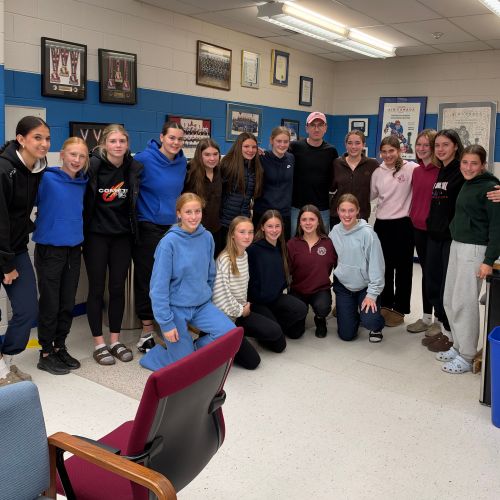
Brock McGillis circa 2018 is a vastly different version from the 43 year-old former hockey player edition who kicked off the fourth season of the Shiftmakers Tour recently, opening with sessions with local competitive minor hockey teams in his hometown of Sudbury.
Yes, much of the change is simply a bi-product of the entirety of his life experience, becoming the first professional hockey player to come out openly as gay, initially looking to provide a modicum of support for others who were travelling in his footsteps.
A biographical short story that appeared in Yahoo Sports in November of 2016 became the catalyst for a phenomenon that has seen the one-time goaltender with the Valley East Cobras and future OHLer who dabbled in the pro ranks for a couple of years now named to the Top 100 People of Power and Influence in Hockey (as compiled by The Hockey News) on three separate occasions.
The ease with which the young man who is also quite a talent in the slo-pitch scene now addresses groups of largely teenage hockey talent stands in stark contrast to his very first presentation at Lasalle Secondary School mere months after he came out, an endeavour for which he spent hours painstakingly trying to recall all significant aspects of his life.
These days, the ultra-polished and highly charismatic advocate for LBGT+ inclusion and beyond has seen a metamorphosis in his whole presentation that extends well beyond the stylistic elements that allow him to connect so well with his audience.
“When I first started, it really was all about LBGT+ inclusion with the emphasis on my story and the impact of language, behavious and attitudes,” said McGillis, just before leaving for the west coast and beginning the cross-Canada trek that will see him bare his soul to upwards of 150 teams or more over the course of the hockey season.
“That is still part of it, but it’s now maybe 5% of a greater story and focus. Over time, it has become about rallying people to create shifts.”
The realization that this end goal was even possible was built, at least in part, on the foundation of off-ice conditioning and training work that McGillis was engaged with in the nickel city more than a decade ago – and the manner in which his athletes began to take to heart the entire notion that language matters, that creating positive cultures and environments in team setting matters.
“It led to all of the local hockey players I was working with kind of making a pact to hold each other accountable for their language,” McGillis continued. “Then they were taking that with them wherever they went. Before I knew it, people I didn’t even know in cities I had never been were doing pushups whenever somebody said something homophobic.”
“That’s why it became Shiftmakers – because we could see people creating these shifts in attitude, in behaviour.”
Ironically, randomness in the midst of his travels has also managed to forge its imprint on his messaging these days – including a stretch a couple of years back in which he questioned a notion that often sits at the very heart of the hockey culture.
“I flippantly said something like: is that brave?,” recalled McGillis. “Suddenly, we were reworking the notion of what is tough and brave. Yes, blocking a shot, taking a hit can be tough and brave. What if we can teach them that it is brave to use your voice, even when you worry your teammates will alienate you.”
“It’s about breaking conformity,” he continued. “Hockey players are so scared to show anything about themselves because of fear of being turned on for it – so everyone simply conforms to the norm. How can I create a safe space for the LBGT+ community if the 95% of the straight athletes can’t even be themselves in that setting?”
As one might imagine, attempting to draw teenage athletes into this very frank conversation is not easy, with much of McGillis’ efforts early on directed towards understanding the ways in which he might be able to engage with his audience.
“I know when I walk into that room that they think they are getting this presentation from the gay guy about pronouns,” he said with a laugh. “That’s the reality. The arms are crossed; they are apprehensive.”
“I need to be as relatable as possible delivering this message in this culture.”
In that sense, McGillis is more than happy to let his work speak for itself.
“I have had more than a thousand players approach me about suicidal thoughts,” said the man who prides himself on maintaining on-going contact with as many of those who reach out as is physically possible.
“They tend to see me as someone who is raw, real and vulnerable.”
And someone who is helping to shape change in the hockey culture, one shift at a time.
