






The only above average temperatures in the past two months, it would seem, came on the weekend of January 9th to January 11th.
Reaching a daytime high that exceeded 5 degrees, the warm spell turned the Queen's Skating Oval into a pond. This was also the weekend that the Sudbury Sprinters were anxiously looking forward to welcoming the remainder of the province to northern Ontario, with the speedskating community gathering for an increasingly rare opporutnity to enjoy outdoors long-track skating.
While the cancellation of same was clearly disappointing, it might be one of the few negatives on the charts for a club that is trending positively in so many ways.
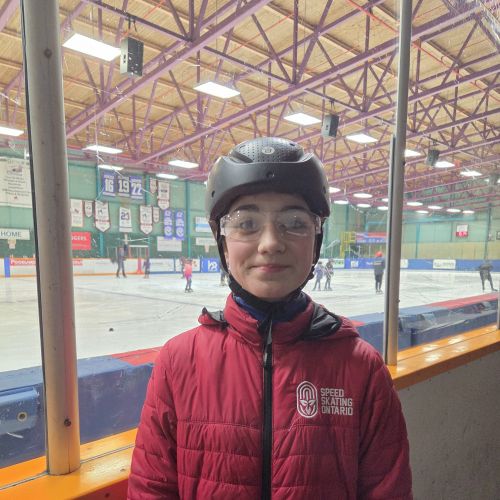
Siblings Mercia and Simone Thompson have both qualified for the 2026 Canadian Youth Long Track Championships scheduled for February 6th to the 8th in Calgary. Meanwhile, Audrey Simard is coming off her first ever appearance at the national youth short track event last March and remains hopeful of cracking the Team Ontario roster again this year - though it won't be easy.
With that in mind, the first and foremost focus for the grade 8 student at Lo-Ellen Park Intermediate School is to sustain the advancement of her skills in a sport that she has enjoyed for some eight years now, initially giving it a shot after watching her brother take a crack.
"Looking back, I can see pictures of me, even just from two years ago, basically standing up while I was skating," said Simard. "I had some bend in my knees and a little bit of a bent back - but now I am so much lower and much more stable - and my crossovers and technique overall have gotten so much better."
For as much as she attributes a portion of this development to the natural physical growth that occurs as she enters her teenage years, Simard acknowledged that she has also devoted far more time and effort, with support from her parents, towards seeing exactly what kind of speedskating potential might lie within the framework of the well-spoken youngster.
"I've done a few camps the past two summers and they really focus on the technical aspects of skating," said Simard. "We get one on ones and a chance to look back at videos that they take."
Still, training is one thing - and racing another landscape altogether - one to which the local product had her eyes opened on a larger stage when it came to competing against the best of the best from right across the country last year.
"I had heard before nationals that Quebec skaters could be very competitive - but I was not expecting them to be physical competitive," she said. "They would block me with their arms and somehow they didn't get disqualified - which happens."
"They're very aggressive," added Simard. "Ontario skaters kind of have a pattern where they are not physically aggressive."
Brody Toering may or may not buck the trend, some day, of Ontario skaters being less aggressive than their counterparts from La Belle Province.
Time will tell.
For now, the grade 7 student at Northeastern Elementary Public School is still taking this all in, balancing his twice a week speedskating practice sessions at the Gerry McCrory Countryside Sports Complex with his commitment to his Nickel Centre Minor Hockey Association Blast houseleague squad.
"They have somewhat similar but different strides," said Toering, who first made the leap to the long blades upon realizing that some of the fastest speedskaters in the world are Dutch; as are some of his father's cousins.
"In hockey, you push more back than sideways and in speedskating, you push more sideways than back."
Many have been those young Sprinters who have noted that the feeling of carrying the blades that typically range from 12 to 18 inches in length is very simply "weird" if you have grown up with hockey skates.
"With crossovers, it felt like my blades would hit one another and that I would trip," said Toering with a smile. Thanks to his commitment to hard work, each and every practice, that fear has all but dissipated as the Garson lad mirrors, in some regards, the progress of his afore-mentioned clubmate.
"At the beginning, I was standing way up," he stated. "Now, I am better at staying low. In the corners, I am turning better and staying closer to the apex. The apex is at the very top of the circle (oval)."
And for a much as Toering has not yet jostled it out in race conditions with his brethren from other provinces, there have been some critical learning moments as he thrust himself into a competitive environment.
"The first few races were very scary, I found," he admitted. "I was generally staying at the back (of the pack) and starting pretty slow so that I didn't get hit. Now, I am getting more comfortable staying in the middle, near second or third place."
By all accounts, that is kind of the sweet spot in terms of positioning, especially when it comes to the longer distances. "You want to be around second or third, mostly to avoid the airflow at the front," said Toering. "Once you get in the final laps, that's when you want to get ahead."
"That's where the passing really comes in."
With a personal best time of 48.56 seconds in the 400m and his sights set on breaking through below the 47.50 second barrier next year, Toering suggested that he should eventually favour races that extend more than twice as long as that.
"I like the 800m, but I don't really have the stamina for it yet," he said. "But I know if I build up my stamina, I would be really good at it."
And for a club with a lot of good things going on - notwithstanding spring weather in January - one can add this to the list.